Pena Palace, Venice, and Prague: Four Travel Frames That Skip the Standard Angle
Four frames from three countries, shot years apart, and none of them is the picture the guidebook wants. Two are Sintra in flat midday sun. One is a Venice canal at night at whatever ISO the body would tolerate. One is a piece of Prague clockwork shot long after the crowd went home. Put them side by side and the common thread is obvious: every one of them was made by refusing the position everyone else was standing in.
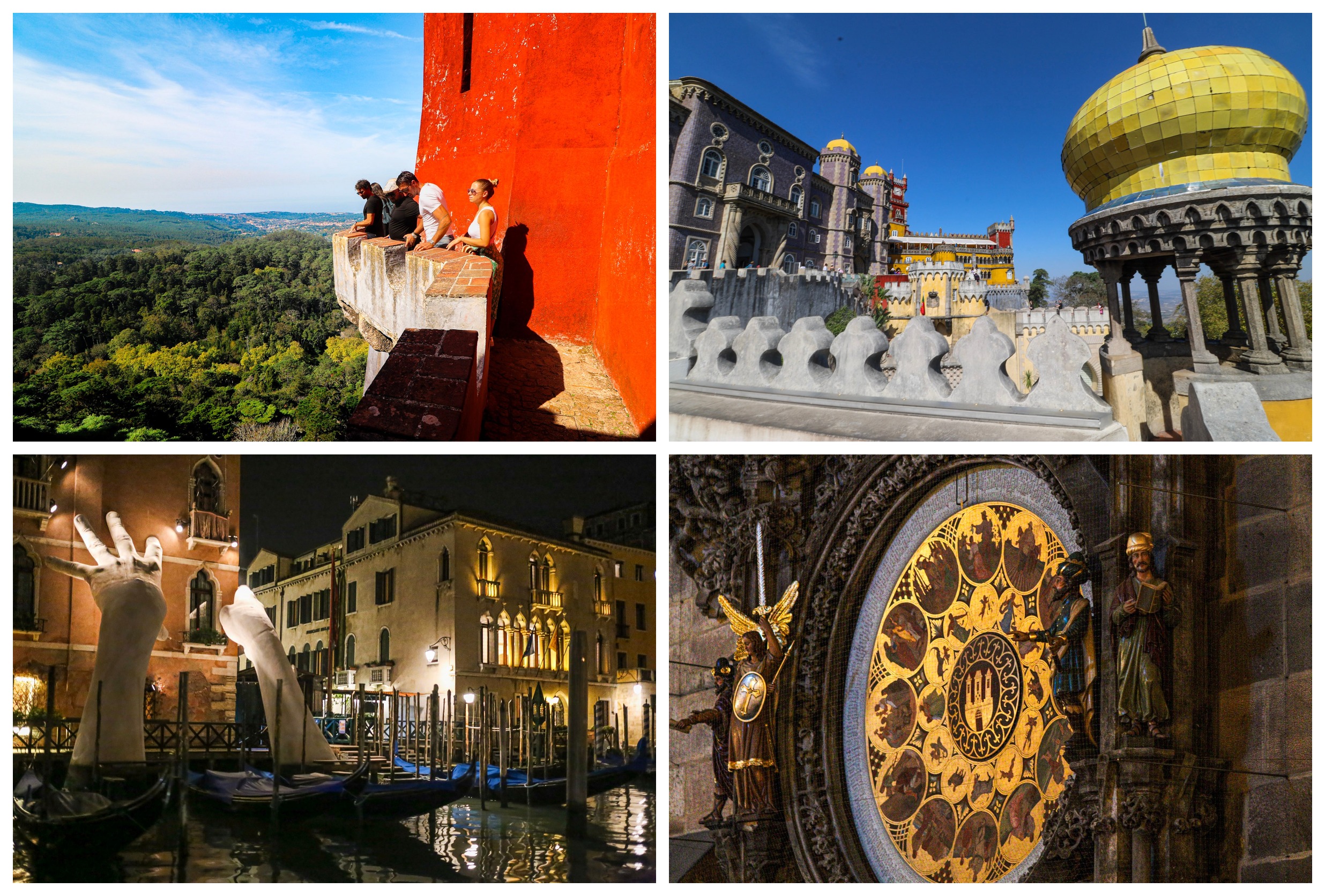
Sintra at noon is a lighting problem, not a lighting failure
The standard advice about harsh overhead light is to wait it out. That is not an option at Pena Palace, where the ticket window and the coach schedule decide when you shoot. So you use what midday gives you, which is saturation and hard edges.
The terrace frame works because the wall is doing two jobs. The ochre-red render fills the right third of the picture as pure colour, and it throws a shadow across the flagstones that gives the foreground something to sit on. The people leaning on the parapet are lit from the side, which is the only reason they read as figures instead of silhouettes. Expose for the wall and the valley behind them collapses into haze; expose for the valley and the wall blows to a flat orange sheet. The compromise is roughly a stop under the wall, which keeps the render textured — you can see the patching and the salt bloom on it — and lets the forest hold its greens.
The second Sintra frame is the opposite approach. Get low, put the crenellations across the bottom of the frame as a serrated foreground, and shoot up so the sky does the separating. A polariser helps here more than it usually does, because glazed tile is a specular surface and the yellow dome only goes properly gold once you kill the sheen on it. The cost is a slightly uneven sky, visible if you look for it in the top corners. Worth it.
Venice after the day-trippers leave
The canal frame is handheld, wide open, and noisy in the shadows. It was that or nothing. Once the light is down to shop windows and a few wall lanterns, the choice is a tripod you probably did not bring or an ISO you would rather not use, and the second option at least lets you shoot from a low angle at the water without setting legs up in a walkway.
What makes the frame is the mismatch of colour temperature. The sculpted hands rising out of the canal are lit near enough to neutral, the facades behind them are deep tungsten, and the water carries both as broken reflections. Correcting globally to white ruins it — the buildings go grey and the whole Venetian character of the scene disappears. Leave the warmth. Pull the hands back toward neutral locally if they need it, and let everything else stay the colour it actually was.
The gondolas matter more than they look. Covered and moored, their blue tarpaulins are the only cool block in the lower half of the frame, and they stop the bottom third from turning into an undifferentiated dark mass.
Prague is a telephoto subject
Everyone shoots the astronomical clock wide, from the square, with the tower and half the sky in it. That picture exists ten million times. The calendar dial rewards the other approach: get back, go long, and let compression flatten the carved figures and the painted plate into one plane.
At night the dial is lit and the stone around it is not, which does the framing for you. The gilt medallions and the coat of arms at the centre carry the exposure; everything outside the ring falls away into the wall. The trade-off is depth of field — at a long focal length and a wide aperture the figures on the right sit slightly softer than the plate — and the protective mesh across the face, which is unavoidable and shows as a faint grid if you sharpen too aggressively.
The trips these frames came out of
Sintra is a half-day out of Lisbon, and the camera bag you carry up to Pena is the same one that has to survive the capital itself, where the seven hills are a physical fact rather than a selling point and every viewpoint costs you a climb. Down in Belém the light problem inverts — limestone instead of painted render — and Jerónimos Monastery turns out to have been built on the same civic logic as the Guggenheim in Bilbao, five hundred years earlier. Bilbao itself is a straightforward subject once you understand how comprehensively the city rebuilt itself out of industrial decline.
The Venice frame is one of a set shot after the last vaporetto, which is the version of the city that no access fee covers and the only time the canal edges are clear enough to shoot from. Daylight Venice is an entirely different exposure exercise: inside St Mark’s, the gold mosaics read far dimmer than the photographs suggest, and metering for them is a decision you have to make before your eyes have adjusted. An hour and a half west, the courtyard at Casa di Giulietta is the hardest small space in the Veneto to photograph, because the balcony was bolted on in the 1930s and the crowds do not care.
Elsewhere on the same circuits: Sicily, where the pebbles at Mazzarò and Isola Bella are the detail nobody warns you about and midday water is a polariser subject; the Dordogne, where the fourth château of a road trip breaks everyone eventually; Bordeaux, where most people shoot the Miroir d’Eau and miss the 18th-century fountain inside the customs museum courtyard. For mixed artificial light of the kind the Venice frame deals with, restaurants are cheap practice — an open kitchen puts copper, steam, and tungsten in one frame and nobody minds you working the room. Further afield, Istanbul sits on two continents and reads differently from each bank, and Ha Long Bay’s 1,600 karst islands are far harder to frame than the brochures let on.
Four subjects that get photographed thousands of times a day. The only variable you control is where you stand.