Tour Buses Are Ad Inventory: What a Madrid City Tour Wrap Actually Sells
A red double-decker swings through the Gran Vía junction at dusk carrying two campaigns at once. The upper flank runs the operator’s own branding beside the Madrid coat of arms and the city tourism wordmark. The rear quarter is a Disney live-tour ad, bought and paid for by somebody with no stake in whether tourists ride the bus at all. Same vinyl, same chassis, two completely separate transactions.
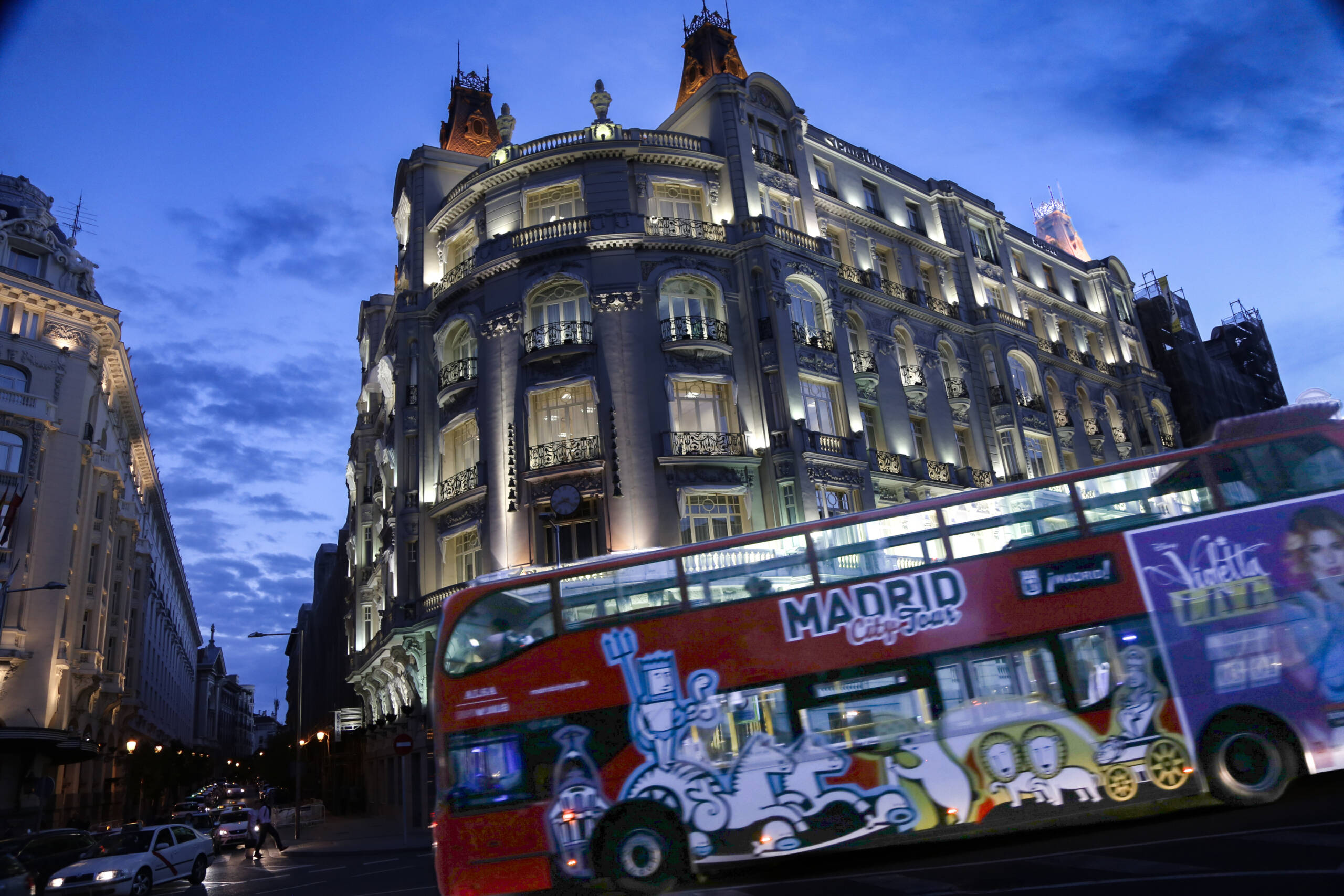
Sightseeing buses get filed under tourism. They belong under media. Madrid City Tour has run since 2011 as the city’s official hop-on service, operated by Grupo Julià and Alsa, and the ticket revenue is only the obvious half of the business. The other half is that the operator is sitting on roughly forty square metres of vertical surface per vehicle, moving at walking pace, through the exact streets that command the highest panel rates in Spain.
The Route Is the Product
Ordinary transit advertising sells you a bus. What you’re really buying is a route, and most routes are mediocre inventory. A city bus spends its day threading residential districts, depot approaches and arterial roads where the only witnesses are drivers already looking at the road.
A sightseeing route is built on the opposite principle. Every stop is a landmark, which means every stop is also a pedestrian density peak. Cibeles, Sol, the Prado, Gran Vía. The vehicle crawls, because crawling is what the passengers paid for. It runs open-top, so the silhouette is odd enough to earn a second look. And it concentrates its running hours in daylight and high season, which is when footfall on those streets peaks.
Planners price wrapped vehicles as a commodity. The good ones notice that this particular commodity is running the best OOH loop in the city, at loitering speed, by design.
The Sell Side Owns the Numbers
Ask what a wrap costs per thousand impressions and you’ll get an answer well under a dollar, cited everywhere, usually traced back to trade association figures that circulate without much re-examination. Set that against a static billboard at several dollars, or paid social in the double digits, and the case looks closed.
It isn’t closed, because nearly every number in that comparison is published by people who sell wraps.
The impression count underneath it rests on circulation-style estimates: how many people were physically near the vehicle’s path. Near is doing a lot of work there. A billboard faces one direction at a fixed height with a known sightline. A bus flank gets occluded by traffic, parked cars, other buses, and its own passengers leaning over the rail. It’s legible for a few seconds, and only from one side, so half the theoretical audience saw the opposite flank.
None of which makes the format bad. It makes the cheapness partly an artefact of a generous counting rule. Buy it because the streets are right, not because a chart said so.
The Audience Is Wrong for Almost Everybody
Here’s the harder problem. The route is optimised for landmarks, so the people standing near it skew visitor rather than resident.
For a Madrid dental clinic or a regional supermarket chain, that’s an expensive way to reach people who leave in four days. For a concert promoter selling a Latin-pop arena tour to teenagers and their parents, it works, because those same streets carry plenty of locals in that bracket. For duty-free, roaming packages, airport transfers, currency exchange, museum passes, a theme park an hour out of town, it’s close to ideal.
So the advertiser mix on sightseeing buses self-selects, and it should. The mistake is treating the inventory as generic urban reach when it’s really a filter with a heavy visitor bias baked in.
Whose Endorsement Is on the Panel
The last piece worth pulling apart is the adjacency. The city’s arms and the official tourism mark ride on the same vehicle as a commercial ad the city didn’t buy and doesn’t earn from.
That’s an asset the operator monetises and the municipality supplies. Implied endorsement is the entire reason an official city tour wrap reads differently from a private coach with the same poster taped to its side. Concession contracts usually carry some clause about acceptable content, and those clauses are where the real arguments happen: gambling, alcohol, political messaging, anything a council would rather not be photographed beside.
Most cities negotiate the ticket price and the route map line by line, then wave the ad revenue through as an operator matter. It’s the highest-margin, least-scrutinised page in the contract.
The bus was never only selling seats.